.webp)


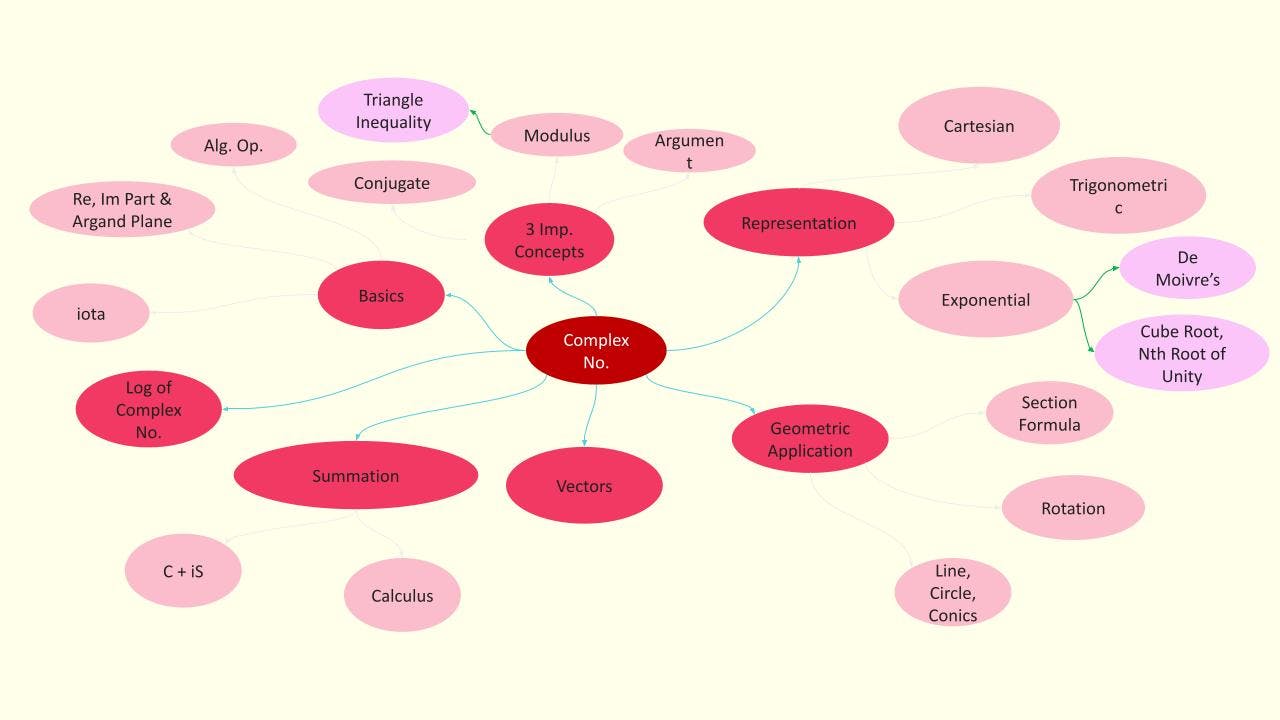
Mastering Complex numbers for the IIT JEE can be tough, but it is immensely rewarding. This topic is an important part of the Math section. Here's a structured approach by senior Math faculty at PracBee to help you confidently tackle this topic.
Before diving into complex numbers, it's essential to have a solid understanding of what they represent.
Complex numbers are written in the form (a + bi) , where (a) and (b) are real numbers, and (i) is the imaginary unit. In IIT JEE, you will often face problems that involve complex numbers. These numbers can be in polar or rectangular forms.
Learning how to represent a complex number on the complex plane.
Familiarizing yourself with basic operations like addition, subtraction, multiplication, and division of complex numbers.
A key aspect of mastering complex numbers involves understanding how to handle powers and roots of complex numbers. For example:
The polar form of a complex number is extremely useful when dealing with powers and roots. You express a complex number in polar form as \(r(\cos \theta + i \sin \theta)\).
Use De Moivre's Theorem to simplify complex numbers raised to any power or to find roots.
IIT JEE tends to focus on questions that require using the polar form or applying De Moivre's Theorem. Be prepared for questions involving these techniques.
The modulus of a complex number is the distance from the origin to the point on the complex plane. The argument is the angle formed with the positive real axis. These two concepts are crucial for solving various questions in the IIT JEE.
You can visualize the addition and subtraction of complex numbers as vector operations in the complex plane.
Multiplication and division are simpler when the numbers are in polar form. You can multiply or divide the moduli and add or subtract the arguments.
Geometrical interpretations of complex number operations often appear in IIT JEE questions. Be sure to practice visualizing these operations to improve your understanding.
Some types of problems frequently appear in the IIT JEE involving complex numbers. These include:
Regularly practicing these types of questions will help build your familiarity with the tricks and methods often used.
Complex numbers also connect with various other chapters in IIT JEE Mathematics, such as coordinate geometry, trigonometry, and calculus. For instance: You can solve many problems in trigonometry more efficiently by using the polar form of complex numbers.
Complex numbers also appear in the solution of differential equations and in integration.
Understanding how complex numbers connect to other topics can help you solve integrated questions on the exam.
Avoid skipping Complex numbers early in your preparation. Many students postpone this topic until the end. However, it connects to many areas of math. Learning it early is helpful.
Don’t rely solely on formulas. Understanding the underlying concepts and geometrical interpretations is essential for solving advanced problems.
Mastering complex numbers requires consistent practice, particularly in handling the polar form, solving equations, and applying geometrical interpretations. Focus on these areas, and you’ll be well-prepared for any Complex number questions that IIT JEE throws your way. Happy studying!


Co-Founder & Senior Mathematics Faculty
B.Tech IIT-Delhi (2009)
IIT Delhi. 15+ Years of experience as Math Faculty and Academics Head


